By Gary Luthy
Based on actual events as remembered 47 years later and verified by R.M. Harding
It is the summer of 1964 and a slow day at camp. Several hikes are out and the remaining groups have had a lazy day around camp. Late in afternoon, the skies have clouded over and wind has picked up from the west. Campers who would normally be at free swim are on their bunks in their tipis discussing dinner menus. In Luthy’s tipi, Hardee Lineham said he had asked the good-looking kitchen girl Jennifer what was for dinner. She had said that Mrs. Bishop got the macaroni out of the storeroom but that they were out of cheese so it would be served with ketchup. There is much discussion if the Y can really offer macaroni three times a week. After all, parents are paying $120 per kid for two weeks of camp. This should allow for hamburger occasionally. Bunkmate, Alan Black pipes up, Jennifer would never tell the truth about the dinner menu. For some reason it is always supposed to be a surprise.
In the meantime, unneeded lifeguard-counsellors Gary Luthy and Rich Harding are standing on the sundeck watching the weather change as Yamnuska disappears from sight and waves start to pick on Bowfort Lake. Out in the swimming area, the raft rises and sinks majestically as the waterslide alternately dips into the lake and then lifts three or four feet in the air. Below the sundeck, the row of aluminum rowboats ride up and down on the waves and start to clank together with a dull metallic sound, their shape amplifying the hollow banging. The only boat not clanking is the cedar strip sailboat. It is moored at the far end of the dock a little way away from the rowboats. Rather than wallowing and clanking, it is urgently pulling at its mooring line, almost as though it wants to escape into the elements for which it was built.W
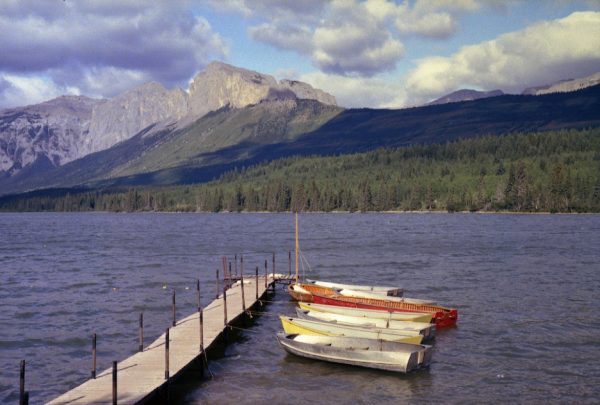
As it starts to spit a bit of rain Harding and Luthy discuss their options. Head for the staff lounge for quick cigarette and pop before “waiters” is called or head back to their tipi groups. Just then, they both notice a wave washing over the end of the dock and their attention is drawn to the sailboat. A third alternative is proposed and quickly accepted.
The sailboat doesn’t get a lot of use. Too small for a whole tipi group to use and heavy enough that it needs a good wind to move, it has sat moored for most of the summer. But the sail is rigged and the centerboard and rudder lie in the bottom of the boat
Harding grabs two of the war surplus kapok life preservers off the rack and Luthy a set of oars in case the sail needs to be augmented with “level two” rowing skills. As they make their way to the end of the dock, the warm wind buffets them and blows at the equipment. Pausing at the end of the dock, they slip the life preservers over their heads and hand the oars down into the boat. Luthy works his way to the back of the boat and ships the rudder and centre-board. Harding starts to raise the sail, letting it flap straight down wind. The boat is ready to go. Harding stands in the bow of the boat and, holding the mast with one hand, pulls the loop of the mooring line over the dock post.
Immediately, with waves and the wind, the boat drifts backwards toward the canoe dock. Harding pushes the sail to the left and Luthy steers right. The little sailboat starts to move forward across the waves. Bringing the sail amidships, the boat starts to slice through the waves. The centerboard thumps on the rocks as the boat nears the canoe dock but then, with rudder and sail adjusted, the wind heels it over, it points toward Salamander Bay and starts to gather speed. Both “sailors” lean on the left gunwale and the boat begins to pick up more speed.
It is exhilarating! The boat is perfectly balanced in the wind and seems to race across the water. To camp staff who have been moving at walking speed all summer, it is like a very wet horse ride where last year’s horseman Brian Gallup has stirred the Indian ponies into a run. The sailcloth snaps in the wind, lake water splashes over the gunwale, the rudder pulls hard, and the rope holding the sail is tight. It is a great place to be when you are 17 and have no worries in the world.
But the boat is almost to Salamander Bay in only seconds, it seems, or at least in less than a couple minutes. Where it takes a Kananaskin camper 10 minutes or a Chiniki 15 minutes to row across the lake, the little sailboat has raced across in about 90 seconds.
Luthy and Harding are facing a challenge. It is well known that the little sailboat does not tack well, if at all. Luthy signals Harding for a turn to the port to try to tack into the wind and come around on course up lake toward the “Pit”. The boat balks at this manoeuvre and comes back on a course toward the bay. Again Harding and Luthy try a tack and again the equipment or the skill level fail the day. Finally, the only option is to turn to the starboard and come around on a course back to the dock. Luthy pushes the rudder across the stern and the bow swings sharply toward Canmore Beach. But almost immediately there is a new gust of wind and the boat, unbalanced now starts to heel the right. Harding throws himself as far as he can over the gunwale to try on hold the boat upright. Luthy lunges too. Then, it’s over. Both the ride and the boat.
The sailboat is upside down in the water. Harding is in the water near the bow holding on and Luthy is floating just off the stern. The water is surprisingly warm and sounds are suddenly different. Where before the sounds were wind, sails, water splashing over the bows and shouts with direction or exhilaration, the shouts now are urgent, the wind sounds louder and the water sounds quieter, more like lapping or gentle splashing. The urgent yelling is to save the centerboard. It is the only piece of equipment that could be lost if it slides out while the boat is overturned. Luthy works his way around to the keel and grabs the centerboard and hangs on.
They try to heel the boat back to upright but the wet sail and the three-foot waves don’t allow this. Finally, they hold tight and assess the situation. They seem to be drifting toward Canmore Beach. All they need to do is hang on and they will eventually have salvation.
Meanwhile, back at the lodge, the alarm has been raised. Assistant Camp Director Harley Smith runs to the waterfront and can see the sailboat overturned in the heaving waves. How many heads are there? How many are there supposed to be?
Harley’s reaction is swift. Grab some oars; grab a life jacket, run to the rowboats. He gets a rowboat loose from the dock, ships the oars and turns the boat into the waves. It takes him a few minutes to get the timing right. Pull the boat up the wave with the oars, keep the boat pointed in the wave, hold, pull again. He makes progress across the lake carefully angling the boat across the waves so he can to head to the point near Salamander Bay where the sailboat wallows.
Luthy and Harding have settled in a routine. Luthy hangs onto the centreboard and keeps it from falling into deep water and Harding keeps other equipment from drifting off. The life preservers have been tamed and are only occasionally smacking the swimmers in the face. Now that the initial excitement of going in the water is over, the new experience of riding the waves into Canmore Beach is actually very relaxing. The water is warm and the experience is unique. Nothing can be done to speed up the process. Lulled into a reverie by the circumstances, the whole world seems reduces to be the little circle of water with Luthy and Harding in the middle waiting to be delivered to shore.
Then… God appears to the mariners!
From their viewpoint four inches above the lake surface with three-foot waves, God in the form of Harley Smith in an aluminum chariot appears above their heads, his boat jerking up and down. Straining at his oars to hold the boat in place he delivers his unearthly shouts above the howling of the wind. Are you all right? What the hell were you doing?
To Luthy and Harding the biggest scare of the adventure is now happening. Not only are they about to be crushed by Harley’s rowboat, they may be in big trouble with the Assistant Camp Director.
Luthy and Harding indicate all is well and point toward Canmore Beach. We’re OK!! No problem! Having fun! All equipment is accounted for. Don’t kill us with that rowboat!
Finally, Harley waves and lets the rowboat drift away. His thoughts as he makes his way back to shore have to do with crazy counsellors! He knows which tipi groups will be chopping wood tomorrow to stoke the fire for the wash-shack water heater!
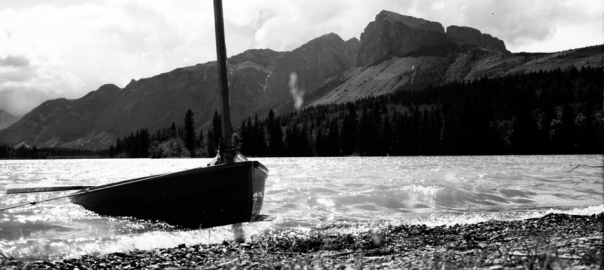
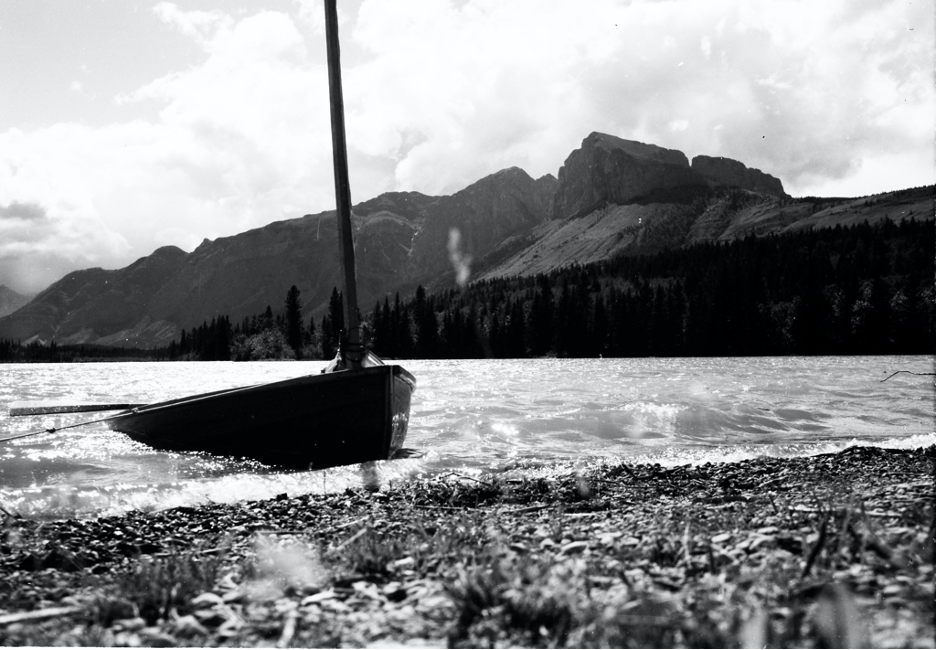
Ten minutes later Harding and Luthy drift onto Canmore Beach. The adventure is over and, out of the water, the wind chills them quickly. They pull up the boat and tie off the painter to a tree to make sure it stays put. Tomorrow, when calm has returned to the lake, they will gather up the equipment and return the boat to dock. Luthy will also photograph the beached boat just to prove that it all happened… and, if necessary, demonstrate to Harley that the boat is in one piece
Luthy jogs back to his tipi and makes it just as the dinner bell is sounding. The campers want to hear what has happened but dinner takes precedent. After a quick change, Luthy and the campers trot down to the lodge, campers Lineham and Black still discussing macaroni.
From the front of the Lodge as he stands ready to lead grace, Harley gives Luthy a stern look as the group enters, only a little late.
“We thank thee Father for thy care and for thy bounty everywhere….”
Yes we do!
And then the waiters return from the kitchen with Mrs. Bishop’s special pizza. It’s made from dry bread, old cheese and leftover breakfast meats. Jennifer has also made Burgundy Grape drink. Yummy! How How!
The world is perfect.